Are Children Targeted for Drug Abuse?

This is a chilling thought for any parent, but here’s a demonstration of how children might be targeted for drug abuse.
Let’s look at the gateway drugs: tobacco, alcohol, and marijuana.
According to the National Center on Addiction and Drug Abuse at Columbia University, if you can get your child to age 21 without their using any of these drugs, they are virtually certain to never start. This is based on their many years of experience working with families, figuring out what sends kids on one path or the other.
But who would want them to smoke cigarettes or drink alcohol at this tender age, anyway? Well, cigarette companies or alcohol manufacturers, to start.
There’s a lot of people who monitor the kind of advertising these companies and track whether or not they seem to be targeting children. Take a look at this research done by the non-profit organization Tobacco-Free Kids. This group uncovered internal documents from some of the tobacco companies, revealing their real intentions. Like these comments:
“Today’s teenager is tomorrow’s potential regular customer, and the overwhelming majority of smokers first begin to smoke while still in their teens…The smoking patterns of teenagers are particularly important to Philip Morris.”
“Evidence is now available to indicate that the 14-18-year-old group is an increasing segment of the smoking population. RJR-T [RJ Reynolds] must soon establish a successful new brand in this market if our position in the industry is to be maintained in the long term.”
http://www.tobaccofreekids.org/research/factsheets/pdf/0008.pdf
Now, the alcohol industry has some standards for advertising that they voluntarily follow that should prevent them from exposing young people to any quantity of alcohol ads. Apparently, that system is not working very well. As David Jernigan, PhD, noted in a recent Huffington Post article:
“In 2009, we found that the average young person between the ages of 12 and 20 saw 366 alcohol ads on television alone — an average of one every day just from TV!”
A report from the Johns Hopkins School of Public Health also noted that “Underage drinkers between the ages of 18 and 20 see more magazine advertising than any other age group for the alcohol brands they consume most heavily.”
Let’s switch gears for a moment to marijuana. According to the annual survey of teens, Monitoring the Future, young people increasingly don’t feel that marijuana use is very harmful. Here is a chart showing the number of high school seniors who think that REGULAR, OCCASIONAL or ONCE/TWICE use of marijuana might be harmful. You can see how these numbers are going down rapidly.
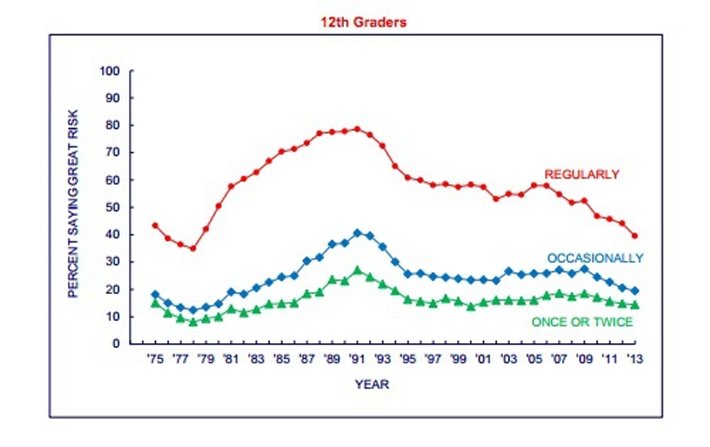
http://monitoringthefuture.org//pubs/monographs/mtf-vol1_2013.pdf
In the 2013 survey, nearly half of all high school seniors had used marijuana at some point, 35% used it in the last year and 23% in the last month. One in 15 used it daily in the month before the survey. So who might be targeting your child for marijuana use? That depends on where you live. It could be a drug dealer. Then again, there is the advertisement that is running in Alaska, to promote the passage of a pro-marijuana bill coming up for a vote.

These three substances are most likely to be the ones that young people will start with if they are going to progress on to other life-threatening drugs like heroin, cocaine and similar drugs.
This shows you why it’s so important not to dismiss the use of marijuana, alcohol or tobacco by your child. If he or she is using these drugs, take action. Get educated on the harm and the likelihood of progressing to other drugs, and then talk to your child. Have as many conversations as are needed to steer him (or her) in the direction of his own goals. Help him deal with frustrations in school and his personal life so he has less reason to want to escape into these substances. Action now could save his life.
We have plenty of information to help you on our website. We know it’s not easy so we have provided you with guides to all the major drugs with plenty of advice on how to approach these subjects with your children.


 ®
® ) on our articles for the most up-to-date and accurate information.